
Cherokee Nation Detention Role
The Cherokee Nation Justice Services page lists several justice functions, including Law Enforcement, Court Bailiffs, Tribal Police Officers, School Resource Officers, Healing to Wellness Program, Detention Operations, court-ordered supervision, sex offender registration and compliance, and security. Its detention operations language is specific. The team ensures safe, secure, compliant custody from sentencing through release, monitors medical and mental health needs, coordinates medical visits, verifies contracted facilities, maintains release schedules, and manages detention agreements.
That description does not create a Cherokee County jail roster. It describes a tribal justice custody and oversight function. A person may be under Cherokee Nation court authority, Marshal Service involvement, a detention agreement, supervision, transport, or release scheduling. Some custody may occur through contracted facilities rather than a public Cherokee Nation jail roster page. For that reason, tribal custody questions should start with Cherokee Nation Justice Services or the Office of the Marshal, not with a county jail roster search.
Cherokee County has a strong local overlap between county, municipal, and tribal justice systems because Tahlequah is the county seat and a central Cherokee Nation justice location. The systems still remain distinct. County jail custody uses Cherokee County Detention Center. Tribal justice questions use Cherokee Nation Justice Services, the Office of the Marshal, and Cherokee Nation District Court. State prison custody uses ODOC. Federal and immigration custody use federal locators.
The image below comes from the Cherokee Nation Justice Services page, the source documenting detention operations and related services.
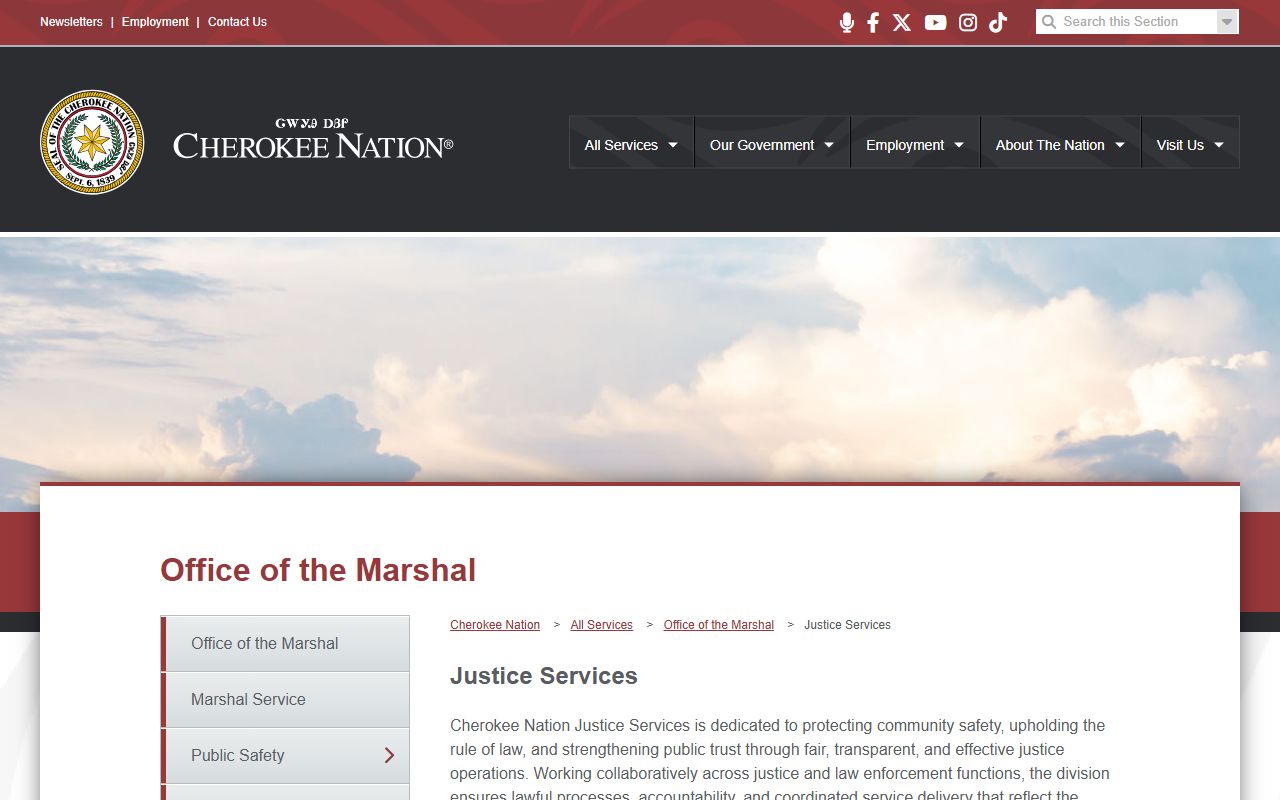
That source supports the tribal detention-operations role without treating it as a county jail roster.
Cherokee Nation Custody Population
No public capacity, bed count, daily population, or roster count was located for Cherokee Nation Justice Services Detention Operations in the research. The official language focuses on detention agreements, custody monitoring, medical and mental health coordination, release schedules, and court-connected functions. Do not apply Cherokee County Detention Center capacity or Vera county jail population figures to Cherokee Nation detention operations.
For a tribal matter, the useful question is not a bed count. The useful question is which authority controls custody and records. If the person is under Cherokee Nation court or Marshal Service authority, Cherokee Nation channels are the first stop. If the person was booked into Cherokee County Detention Center, the county jail controls custody questions. If the person was sentenced to ODOC, the state locator controls. If a federal agency is involved, BOP, USMS, or ICE may control the next search.
| System | Who It Covers | Lookup Starting Point |
|---|---|---|
| Cherokee Nation Justice Services | Tribal justice custody, detention agreements, supervision, release coordination | Justice Services or Office of the Marshal |
| Cherokee County Detention Center | County jail detainees and local bookings | Detention center phone and county custody channels |
| Oklahoma DOC | Sentenced state prisoners | OK Offender Lookup |
| Federal or ICE custody | Federal criminal or immigration detainees | BOP locator, USMS district, or ICE ODLS |
Lookup Cherokee Nation Detention Status
The correct lookup path depends on whether the case is tribal, county, state, or federal. For a Cherokee Nation court or Marshal Service matter, contact Cherokee Nation Office of the Marshal or Justice Services. For a court docket, use Cherokee Nation District Court resources. For a county jail booking after a local arrest, call Cherokee County Detention Center. The county jail page is not a substitute for tribal custody confirmation.
Tribal justice records can intersect with county records, but one system does not replace the other. A person may have a county court case in ODCR, a Cherokee Nation court matter, a county jail booking, or a detention agreement. Keep the agency names straight when calling. Ask whether the person is physically housed by a contracted facility, whether the person is under supervision rather than jail custody, and whether a release schedule is managed by Cherokee Nation Justice Services.
- Identify whether the matter is Cherokee Nation, county district court, state DOC, federal, or immigration.
- Call Cherokee Nation Justice Services or the Office of the Marshal for tribal custody and detention-agreement questions.
- Use Cherokee Nation District Court for tribal dockets and court clerk contact.
- Use county, ODOC, BOP, or ICE locators only when that custody authority applies.
Tribal distinction: Cherokee Nation detention operations manage tribal justice custody work and agreements, not Cherokee County's public jail roster.
Cherokee Nation Detention Contact
Justice Services contact information should be used for adult justice services, detention operations, release-schedule questions, detention agreements, and related tribal justice services. The research also identifies the Office of the Marshal as a law enforcement contact point and Cherokee Nation District Court as the court docket path.
Cherokee Nation Justice Services
P.O. Box 948
Tahlequah, OK 74465
918-453-5610
Adult Justice Services email: justice-services@cherokee.org
Cherokee Nation Office of the Marshal
Cherokee Nation Marshal Service
Tahlequah, OK
918-207-3800
Use for Cherokee Nation law enforcement and Marshal Service routing.
Tribal Courthouse Dockets
17675 S. Muskogee Ave.
Tahlequah, OK 74464
Dockets listed first, third, and fourth Wednesdays at 9:00 a.m.
Confirm docket status with Cherokee Nation District Court before travel.
Cherokee Nation Detention Visits
No public visitation schedule for Cherokee Nation Justice Services Detention Operations was located in the research. Because the official page describes detention agreements and custody monitoring, a visit may depend on the contracted facility, court order, housing location, medical status, classification, or release plan. Do not apply Cherokee County Detention Center visitation rules to a tribal detention agreement unless Cherokee Nation or the housing facility directs that path.
Ask three questions before travel. Is the person in physical custody or under court-ordered supervision? Which facility is housing the person? Which agency approves visits, attorney contact, mail, or release information? The answer may be Cherokee Nation, a contracted detention facility, a county jail, or a court office.
| Visit Question | Published Status | What to Confirm |
|---|---|---|
| Public tribal detention schedule | No schedule located | Call Justice Services |
| Contract facility visit rule | Not identified in public page | Ask where the person is housed |
| Tribal court docket appearance | First, third, and fourth Wednesdays at 9:00 a.m. listed for dockets | Confirm with Cherokee Nation District Court |
| County jail visit rule | Separate county system | Use only if housed at Cherokee County Detention Center |
Cherokee Nation Mail and Money
No Cherokee Nation detention operations mail format, commissary vendor, phone-account vendor, or deposit fee schedule was located in the public research. Because detention operations may involve contracted facilities, the correct mail and money instructions may come from the facility that physically houses the person. Do not use Tiger Commissary or NCIC unless the person is housed at Cherokee County Detention Center and the county jail confirms that those services apply.
State DOC money rules are also separate. ODOC uses JPay, MoneyGram, money order directions, and state digital mail rules for state inmates. Those rules are not tribal detention rules. Federal and ICE custody have their own systems as well. The safest request is specific: ask Cherokee Nation Justice Services where the person is housed and which office or vendor controls mail, phone, money, and release information.
| Service | Documented Cherokee Nation Detail | Important Limit |
|---|---|---|
| No public format located | Ask where the person is physically housed | |
| Commissary or deposits | No public vendor located | Do not assume county jail vendors apply |
| Phone or video | No public vendor located | Ask Justice Services or housing facility |
| Release schedule | Justice Services manages release schedules in official page language | Confirm directly with Justice Services |
Cherokee Nation Court Custody
Cherokee Nation District Court is a separate path from Cherokee County District Court. The research identifies the Cherokee Nation District Court page as the source for the tribal court public portal and court clerk contact context. It also notes docket activity at the Tribal Courthouse in Tahlequah. For a tribal case, use Cherokee Nation court resources instead of assuming the case will appear in Oklahoma district court systems.
Some people may have more than one record track. A county arrest can later involve tribal, state, federal, or immigration custody, and a tribal matter can involve contracted detention. ODCR and OSCN are useful for Oklahoma district court records. Cherokee Nation court resources are useful for tribal court matters. County jail calls answer county custody. Justice Services answers tribal detention-operations questions where it has authority.
- Detention agreement
- An arrangement for custody or housing managed under a justice agency's authority.
- Tribal docket
- A court schedule for Cherokee Nation District Court matters.
- Release schedule
- A custody timeline managed by the responsible detention or court authority.
Cherokee Nation Custody Boundaries
The strongest local rule is separation of systems. Cherokee County Detention Center is a county jail trust authority. Tahlequah and Hulbert police are municipal arresting agencies. Cherokee Nation Justice Services is a tribal justice operation with detention operations, supervision, court safety, transport, and detention-agreement duties. ODOC handles state prisoners. BOP and ICE handle federal and immigration custody.
That separation helps prevent bad lookup results. A person not found through county custody may still have a tribal case, a state sentence, a federal hold, or a release from custody. Ask which agency has legal and physical custody, then use the locator or records office for that agency. Cherokee County inmate population data can describe local custody patterns, but only the responsible office can confirm a specific person's status.
Note: Confirm the custody authority and physical housing location before sending mail, money, or visitors.
Public Record Search
Sponsored Results